Seasonal temperature change affects every part of automotive refinishing: material viscosity, solvent evaporation, atomization quality, flash-off speed, booth airflow, and painter rhythm. A gun that performed perfectly in spring can create orange peel in winter or dry spray in summer if the technician keeps the same settings without checking the conditions. Stable spray performance comes from adjusting the process before the first panel is coated.
Coatings become thicker in low temperature and thinner in high temperature. In winter, cold basecoat or clearcoat may atomize poorly, forcing the painter to raise pressure or slow down too much. In summer, hot material may flash quickly, leaving dry edges and rough texture. Store paint, clearcoat, hardener, and reducer in a controlled room whenever possible.
Before mixing, allow material to reach the recommended working temperature. Do not warm paint with unsafe heat sources. Use the correct seasonal reducer or hardener speed according to the technical data sheet. Material temperature control is more effective than trying to correct everything at the gun.
Compressed air behavior changes with temperature and humidity. Condensation in air lines increases during seasonal transitions, and moisture contamination can cause fisheyes, blushing, or poor curing. Drain the compressor, check filters, confirm regulator accuracy, and test the fan pattern on paper before each major job.
When setting an air spray gun, measure pressure at the gun inlet with the trigger fully pulled. A wall regulator reading alone is not enough because hose length, fittings, and air consumption affect real delivery pressure. In cold conditions, slightly improved atomization may be needed, but stay inside the coating supplier's recommended range.
In summer, solvent leaves the film faster. Keep the gun distance controlled, avoid over-reducing fan edges, and use the correct slower reducer when the booth is hot. In winter, extend flash time as specified, avoid heavy wet coats, and confirm the panel temperature is not below the coating requirement. If the surface is cold, the coating may look wet but cure slowly underneath.
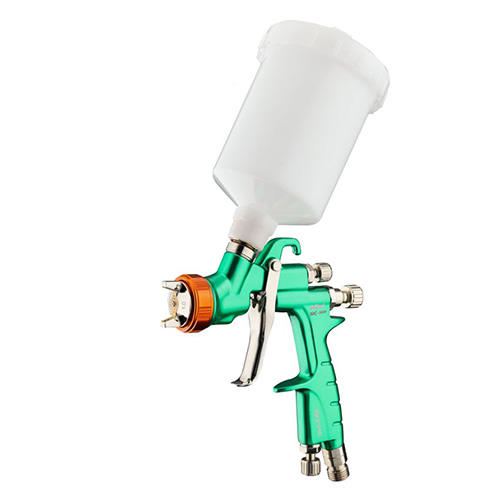
The LVLP Spray Gun Craft Alloy Body, Consistent Dispensing construction can help maintain predictable material output during seasonal changes, but the painter still needs to adjust reducer speed, booth temperature, overlap, and flash timing. Hardware stability and process stability must work together.
Temperature changes can make residue inside the fluid passage harder to notice. Clean the needle, nozzle, and air cap immediately after spraying, then dry the passages with clean air. Check cup seals and air cap holes because small contamination becomes more obvious when viscosity changes.
Build a seasonal setup sheet for the workshop. Record booth temperature, material temperature, reducer speed, inlet pressure, nozzle size, flash time, and observed surface result. After several weeks, the shop will have a practical database for summer, winter, and transition months.
Stable spray gun performance is not achieved by one universal setting. It comes from checking environmental conditions, controlling material temperature, maintaining dry air, testing the fan, and adjusting flash-off strategy before defects appear on the customer's vehicle.
Wenzhou Sico Spraying Tech.Co.,Ltd
Add: Daqiao Industrial Area,Beibaixiang Town,Yueqing,Wenzhou,Zhejiang
Zip code:325603
Tel:+86-577-67307836
Email:sales@sicotools.com
Mobile/Wechat:+86-13777716892


...
These SK-300 spray guns are fantastic! Love the no oring design, less leakage and easy maintenance. The atomization is perfect for automotive painting. Highly recommend!
Spiro Pittas,AustraliaPRD-817 gives me precise control over color, gloss, and gradients-art-level finish without top-tier pricing”
Olie-PaintzPRD-817 gives me precise control over color, gloss, and gradients-art-level finish without top-tier pricing”
Olie-PaintzPRD-817 gives me precise control over color, gloss, and gradients-art-level finish without top-tier pricing”
Olie-PaintzPRD-817 gives me precise control over color, gloss, and gradients-art-level finish without top-tier pricing”
Olie-Paintz


